

Workshops
Registration now open: GETTING STARTED WITH GIT & GITLAB
A Hands‑On Workshop for Students & Young Researchers – Managing Scripts & Code in the Life Sciences
09.11.2026 01:00 PM - 04:00 PM JGU Campus, GFG (Georg-Forster-Gebäude), Room 01 711What you'll walk away with
- A local Git repository on your computer and a remote project on GitLab.
- The ability to clone, commit, branch, merge and resolve conflicts.
- Knowledge of how to organize scripts and code for personal and collaborative projects.
- First experience with some of the collaborative tools in GitLab: issues, merge requests and wikis.

We are pleased to invite you to participate in the upcoming 3rdCHA-IQCB Symposium, which will be held on 17 November 2026 at the Institute of Molecular Biology (IMB). This workshop will bring together CHA researchers to discuss key topics in the field of ageing research. In addition, we will feature two exciting keynote speakers:
- Maria Mittelbrunn (Spanish National Center for Cardiovascular Research, Madrid (Spain); Columbia University, New York (USA))
- Wolfgang Wagner (University Medical Centre RWTH Aachen (Germany))
Besides inviting you and your colleagues to attend, we would ask you to have a representative from your team present a poster relating to your ageing-related research during the Poster Session & Social Event in our lunch break. This session will provide an excellent platform to showcase your research on ageing and contribute to the broader scientific discussions taking place during the event.
We believe your contribution would greatly enhance the diversity and depth of the research presented at the workshop. Please respond by October 20 to our registration form how many people of your lab will participate (so we can calculate for food & drink) and who from your group will present a poster.
We look forward to your positive response and hope to welcome you all to the workshop.
AI IN BIOSCIENCE: CONVERGING INTERESTS AND JOINT SOLUTIONS
Got a bioscience dataset you can't model, or an algorithm without a biological use case? Workshop by and for Young Researchers
27.10.2026 - 28.10.2026 9:00 am - 7:00 pm FAVORITE Parkhotel Mainz, GermanyThe IQCB, in partnership with ReALity and the JGU Scotland HUB × SULSA, is pleased to announce "AI in Bioscience: Converging Interests and Joint Solutions", a workshop by and for young researchers, taking place on 27 and 28 October 2026 at the FAVORITE Parkhotel in Mainz, Germany.
Artificial intelligence is rapidly transforming research in bioscience, yet meaningful collaboration between computational and experimental scientists often remains hindered by disciplinary boundaries, differing research cultures, and unresolved methodological challenges. Rather than showcasing completed projects, this workshop will provide a dedicated forum for PhD candidates, postdoctoral researchers, and selected keynote speakers from bioscience and AI to openly discuss current bottlenecks, unmet needs, and emerging opportunities at the interface of both fields.
Through interactive discussions and participant-driven problem-sharing sessions, the workshop aims to identify common challenges, such as limitations in biological data analysis, issues of model validation and interpretability, the entire scientific research workflow, and barriers to translating computational advances into experimental practice. By focusing on problems rather than achievements, the event seeks to foster mutual understanding and establish a shared foundation for future interdisciplinary collaboration.
The programme spans one and a half days of presentations, alongside a poster session running throughout the breaks so that every participant can present their own Blind Spot, followed by half a day of breakout sessions held in small groups of 6–10 participants.
As part of registration, attendees are invited to submit a "Blind Spot": a dataset they don’t know how to model, or an algorithm in search of a bioscience use case. Submitted Blind Spots form the basis for selection, as places are limited to around 50 participants. The results of these two days – the clustered gaps, breakout-group findings, and literature search – will be carried forward into a separate follow-up retreat. There they are the basis for a community-driven white paper on future teaching of biosciences.
What We Aim to Achieve
- Deepen dialogue and mutual understanding between researchers in bioscience and artificial intelligence.
- Identify and cluster shared methodological and conceptual challenges (" Blind Spots") presented by speakers and attendees, as a basis for interdisciplinary approaches.
- Bring academic and industry representatives together for direct exchange.
- Produce a structured summary of gaps and breakout-group results that carries forward into a separate, subsequent retreat, laying the groundwork there for a community-driven white paper and a concrete teaching curriculum that prepares the next generation of quantitative bioscientists to bridge exactly these gaps.
Who Should Attend
The workshop is aimed at PhD candidates and postdoctoral researchers with hands-on experience in bioscience or computational research, alongside selected keynote speakers from bioscience and AI, and industry representatives. Participation is open to researchers from outside JGU Mainz and from abroad.
Keynote Speakers
Dr. Hajk Drost – University of Dundee
Dr. Georges Hattab – Robert Koch-Institute
Dr. Konrad Rawlik – University of Edinburgh
Dr. Beck Strohmer – University of St Andrews, University of Copenhagen
Alexander Treber – Boehringer Ingelheim International GmbH
Dr. Paula Wagner Egea – BioMed X Paris
Who’s Coming
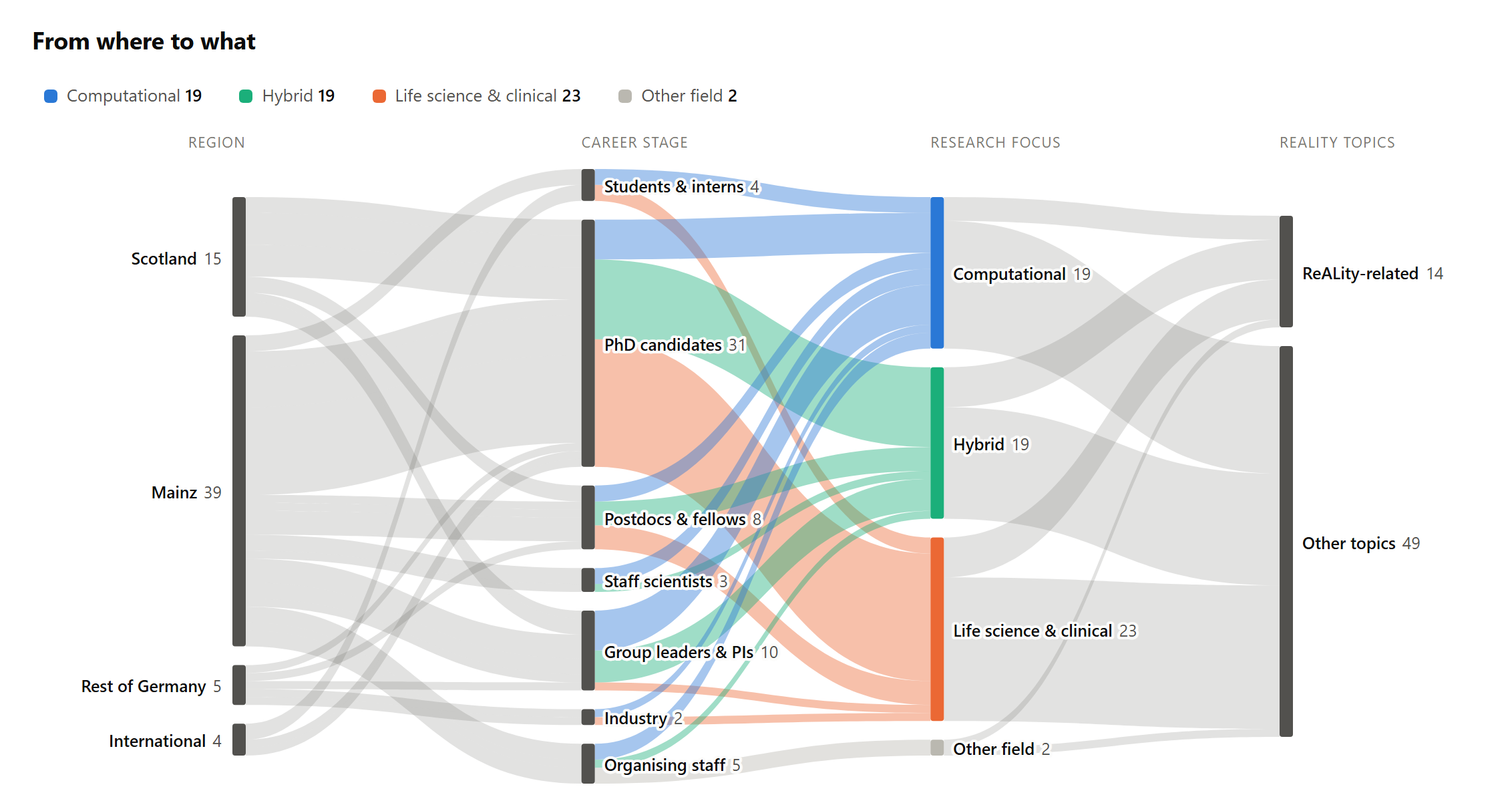
Open the interactive chart – hover for details, click a research focus to trace it through the flow.
Registration has closed.
No registration fee.
The workshop is organised by the IQCB together with ReALity and the JGU Scotland HUB × SULSA, and is funded by the Ministry of Science, Further Education and Health of Rhineland-Pfalz and the Scottish Government as part of the Rheinland-Pfalz & Scotland Life Sciences Partnership.
LONG-READ SEQUENCING COMMUNITY MEETUP
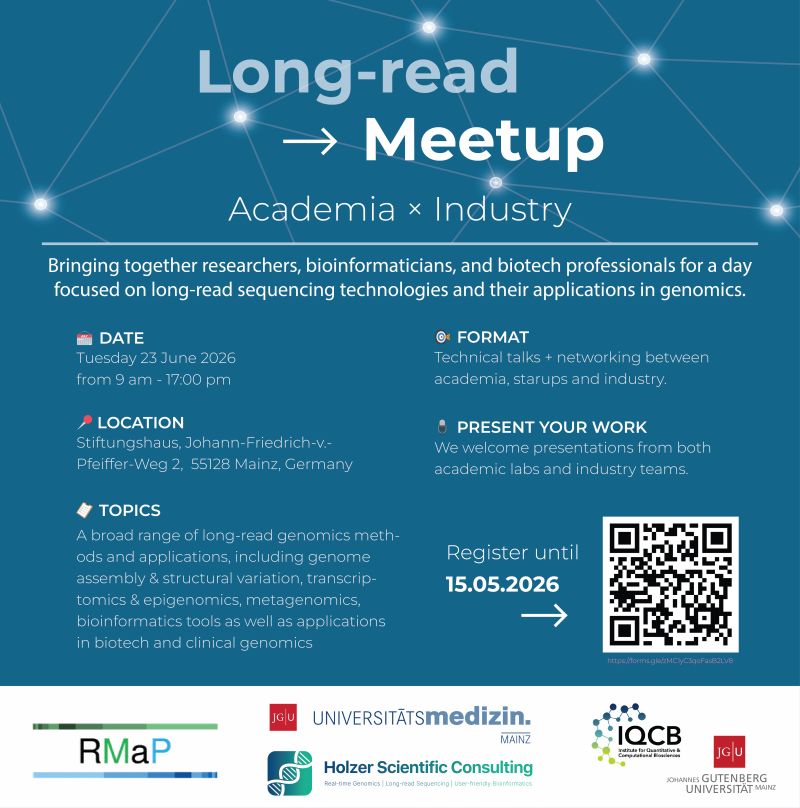
23.06.2026 9:00 am - 5:00 pm Stiftungshaus (Johann-Friedrich-v.-Pfeiffer-Weg 2) Foyer, Mainz UniversityWe’re excited to announce an upcoming full-day community meetup dedicated to long-read sequencing technologies. The event will bring together researchers, bioinformaticians, and industry professionals working with long-read approaches to share insights, present their work, and connect with the local community.
The program will feature scientific talks and application-focused presentations spanning a broad range of topics, including genetics, epigenetics, transcriptomics, epitranscriptomics, and other applications enabled by long-read sequencing.
The registration deadline has expired.
Whether you’re an expert in long-read sequencing or just beginning to explore its potential, this event offers a chance for researchers, industry professionals, and startups to exchange ideas, showcase innovations, and connect within the regional long-read genomics community.
BRIDGING THE GAP BETWEEN MOLECULAR INNOVATION AND SYSTEMS ENGINEERING
21.05.2026 09:30 AM - 02:30 PM Seminar room at IMB, Ackermannweg 4, 55128 MainzJoint free of charge / registration mandatory workshop by IQCB and Fraunhofer IESE (Kaiserslautern) with involvement of the Institute of Molecular Biology, the ReALity Initiative and the Center for Healthy Aging.
The workshop will explore how high-integrity software engineering can accelerate basic research and the clinical translation of advanced therapies. The short talks are aligned with the following thematic pillars:
1. The “Reliability Gap” in AI:
As AI gains prominence in research and we move toward AI-driven personalized digital health, how do we ensure safety, reliability, and reproducibility? How can high-integrity data engineering ensure that machine learning outcomes are reproducible and verifiable?
2. Digital Twins and Modeling Biological Complexity:
Where molecular modeling meets systems engineering to create predictive models for system- or patient-level responses.
3. Translating Advanced Therapy Medicinal Products (ATMPs) to the Bedside:
Mainz plays a prominent role in the development of gene therapy medicinal products, CAR-T cell workflows, and tissue regeneration. Moving from experimental protocols to standardized clinical products presents challenges where interdisciplinary interactions are often transformative.
4. Engineering for an Aging Society:
How can we better integrate personalized medicine into long-term care? We seek perspectives on developing AI solutions that remain robust and ethical when applied to the multi-morbidities of an aging population.
Find the agenda here.
GETTING STARTED WITH GIT & GITLAB
A Hands‑On Workshop for Students & Young Researchers – Managing Scripts & Code in the Life Sciences
04.03.2026 02:00 PM - 05:00 PM JGU Campus, GFG (Georg-Forster-Gebäude), Room 01 711Wednesday, 04 March 2:00 pm - 5:00 pm
🎯 What you'll walk away with
- A local Git repository on your computer and a remote project on GitLab.
- The ability to clone, commit, branch, merge and resolve conflicts.
- Knowledge of how to organize scripts and code for personal and collaborative projects.
- First experience with some of the collaborative tools in GitLab: issues, merge requests and wikis.
We look forward to welcoming you all again for the second time at the Institute of Molecular Biology (IMB).
Registration closed!
GETTING STARTED WITH GIT & GITLAB
A Hands‑On Workshop for Students & Young Researchers – Managing Scripts & Code in the Life Sciences
02:30 PM - 05:30 PM JGU CampusTuesday, 28 October 2:30 pm - 5:30 pm
🎯 What you'll walk away with
- A local Git repository on your computer and a remote project on GitLab.
- The ability to clone, commit, branch, merge and resolve conflicts.
- Knowledge of how to organize scripts and code for personal and collaborative projects.
- First experience with some of the collaborative tools in GitLab: issues, merge requests and wikis.
Stay tuned: more information including the agenda and the link to the registration will follow.
LABORATORY AUTOMATION
Gutenberg Workshop supported by IQCB
03.06.-05.06.2025 Helmholtz-Institute Mainzdownload flyerRESEARCH DATA MANAGEMENT OF IMAGE DATA USING OMERO
with Dr. Tom Boissonnet from the Center for Advanced Imaging, Heinrich Heine University Düsseldorf
11:00 AM - 4:00 PM Johannes Gutenberg University Mainz, BioZentrum Idownload flyerWith great support from NFDI4BIOIMAGE, the I3D:bio project, SFB 1551, and the IQCB, this workshop will focus on the management of image data from various advanced imaging techniques, including light microscopy, electron microscopy, and medical imaging (X-ray, CT, MRI, etc.). The workshop will feature OMERO, a powerful data management platform designed to streamline the organization, storage, annotation, and analysis of complex image datasets. Additionally, you will learn about the existing infrastructure and the ongoing initiative to establish an OMERO server at JGU, which will soon be accessible to all researchers on campus.
The hands-on session, scheduled from 2 PM to 4 PM, is limited to 20 participants. Therefore, prior registration is required. Please register here
AI FOR SCIENTIFIC DISCOVERY
Gutenberg Workshop supported by IQCB
02.09.-04.09.2024 WASEM´s Monastery, Edelgasse 15, 55218 Ingelheim, Germany applications until 24.06.24download flyerThis Gutenberg Workshop will provide a fascinating journey through the world of automated scientific discovery, driven by artificial intelligence. It is organized around the following four main themes:
1. Automation and autonomy in science
2. Applications of AI, with an emphasis on, but not exclusively, the life sciences
3. Equation discovery, symbolic regression, and the induction of process models
4. Integration efforts
DATA MINING OF HUMAN POPULATION COHORTS
Hands-on Computational Biology Workshop
09:00 AM - 14:30 PM Johannes Gutenberg University Mainz, BioZentrum I, Germany applications until 01.03.24with
Heiko Runz, EMBL Heidelberg, Heidelberg-Mannheim Health + Life Science Alliance
Juha Karjalainen, Regeneron Genetics Center/ FIMM / Broad Institute
Helena Cornu, Open Targets / European Bioinformatics Institute
In this hands-on session, you will have the opportunity to explore and analyze human genetic and
genomic datasets to address questions related to specific genes or topics of your choice. Learn how
to extract genetic hypotheses regarding rare & common diseases related to your genes of interest
from human population cohorts.
Target group: Advanced Life Science researchers from JGU, IMB, LIR, UM, TRON
Fee: 50 EUR
Also join the “Under The Hood” Seminar with Juha Karjalainen after the workshop at 3:30 PM. Read more here
EAI MEETS IQCB WINTER SCHOOL
Self-Organization on Machine Learning
11.12.-13.12.2023 Nierstein, Germany applications until 07.11.23This winter school aims to explore the role of self-organization in machine learning, focusing on the latest research and applications. The topic will be based on the research.
EAI MEETS IQCB WORKSHOP - BRIDGING DISCIPLINES
Novel AI driven interdisciplinary methods
06.12.-08.12.2023 MPI-P, on Campus of the Johannes Gutenberg-University Mainz, Germany applications until 07.11.23This workshop aims to bring together experts from a broad range of different perspectives and backgrounds regarding their scientific research and AI driven computational methods with early researchers to strengthen the interdisciplinary dialog for science informed modelling and machine learning techniques.
Read more here
Link to Program